
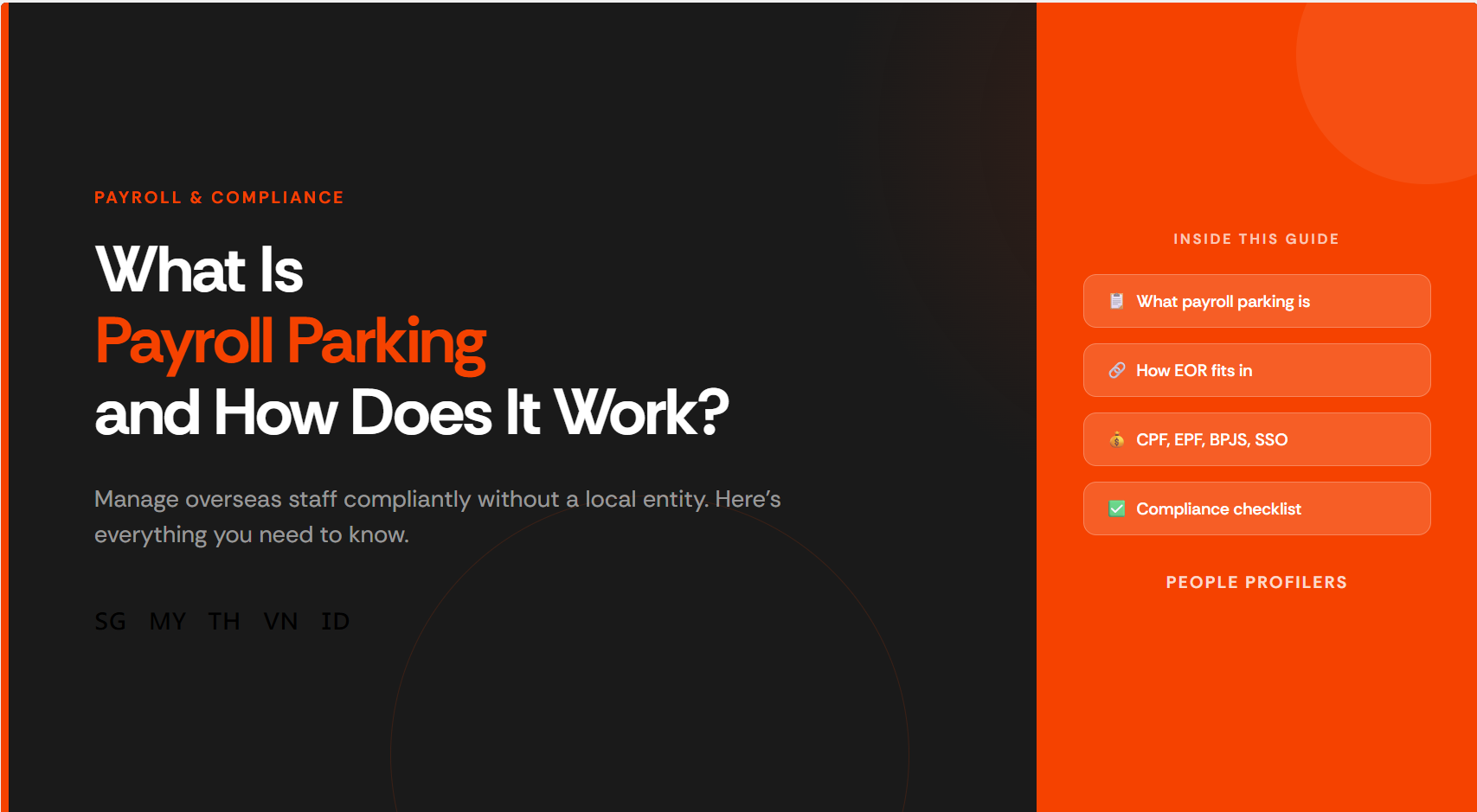
Navigating Payroll Parking in Vietnam — How Employer of Record (EOR) Services Work
One efficient way to manage your company’s talent and staffing in Vietnam is with Payroll Parking. In Vietnam, Payroll Parking utilises Employer of Record (EOR) services to manage HR operations so that management can focus on more critical business functions.
Through Payroll Parking, businesses can leverage the expertise of HR and workforce solutions providers like People Profilers to manage employee onboarding, payroll administration, statutory contributions, employee benefits, tax deductions, and compliance requirements while staying up to date with Vietnam’s employment laws. Employers in Vietnam commonly rely on the Labour Code (Law No. 45/2019/QH14) as the primary framework governing employment standards.
Vietnam employers are also required to manage statutory payroll obligations such as Social Insurance (SI), Health Insurance (HI), and Unemployment Insurance (UI) contributions, personal income tax submissions to the General Department of Taxation, and trade union contributions under the Vietnam General Confederation of Labour.
Through Payroll Parking, companies can rely on an Employer of Record to handle these requirements accurately and on time, without having to build and supervise a full in-house HR and payroll department. This can be especially valuable for overseas businesses entering Vietnam, regional companies hiring locally for the first time, or organisations that want a compliant employment structure without setting up a full legal entity immediately.
The arrangement provides operational flexibility while reducing the administrative burden associated with payroll processing and labour law compliance.
What Exactly is Payroll Parking?
Payroll Parking is essentially the outsourcing of your HR and employment administration to a third-party organisation that serves as your Employer of Record. As your EOR, this third party legally employs your workers under its organisation and takes responsibility for the employment-related paperwork and employer obligations attached to that workforce.
This includes preparing compliant employment contracts, processing monthly salaries, administering statutory deductions and employer contributions, handling personal income tax reporting, and managing insurance and employee benefits. The EOR becomes the legal employer on record, while your company continues to direct the employee’s day-to-day work, performance expectations, deliverables, and business priorities.
In other words, the EOR handles the employment infrastructure, while you retain operational control over the employee’s actual work. This model is especially useful when businesses need to hire quickly, want to reduce compliance exposure, or need a practical solution for cross-border or project-based workforce expansion.
Learn more about our EOR / Payroll Parking services in Vietnam.
How Does Payroll Parking Work in Vietnam?
The process usually begins when your company enters into an agreement with an Employer of Record to provide the relevant HR and payroll services. This agreement typically sets out the scope of services, the responsibilities of each party, the fee structure, and the compliance obligations that apply to the arrangement.
Once the agreement is in place, the employee is onboarded under the EOR entity in Vietnam. This involves gathering the employee’s personal details, tax and statutory registration information, and the necessary employment documentation. The EOR then prepares the employment contract and related records in line with Vietnam’s regulatory requirements.
This onboarding process is important because payroll compliance in Vietnam involves not only salary administration but also proper employee registration with social insurance authorities and tax authorities. Employers must ensure that employees are registered correctly and that contributions and taxes are submitted in accordance with local regulations.
After onboarding, the Employer of Record assumes responsibility for payroll administration. This typically includes computing monthly wages, preparing payroll records, processing salary disbursement, administering leave-related payments where applicable, and making the relevant statutory submissions.
In Vietnam, this generally includes:
- Social Insurance (SI), Health Insurance (HI), and Unemployment Insurance (UI) contributions
- Personal income tax (PIT) submissions
- Trade union contributions
Employers are required to meet statutory deadlines for contributions and tax submissions. With Payroll Parking, the EOR takes care of these recurring administrative requirements so your business can focus on operations instead of payroll deadlines.
Apart from payroll processing, the EOR is also responsible for monitoring compliance with local employment requirements. This includes working hours, overtime pay, leave entitlements, termination rules, and statutory record-keeping obligations.
Depending on the employee profile and company policies, the EOR may also administer additional benefits such as health insurance, social insurance, work injury and occupational disease insurance, and other employee perks.
Where relevant, the EOR can assist with employee relations matters, such as administrative grievances, disciplinary documentation, or payroll-related clarifications. However, even though the EOR is the legal employer on record, your company continues to manage the employee’s day-to-day supervision, reporting lines, job scope, targets, and work output.
This separation is one of the key strengths of Payroll Parking—it allows employers to maintain business control while outsourcing employment administration to specialists.
What Are the Benefits of Payroll Parking in Vietnam?
Many businesses use Payroll Parking in Vietnam because it simplifies workforce management while ensuring compliance with local employment regulations. For foreign companies, it enables quick hiring without establishing a local entity. For local and regional companies, it helps centralise HR operations and reduce administrative workload.
Payroll Parking also reduces compliance risks. Employers in Vietnam must manage multiple statutory obligations simultaneously, including social insurance contributions, tax submissions, and labour compliance requirements. Errors or delays can lead to penalties and operational disruptions.
By outsourcing these functions to an experienced EOR provider, companies can improve payroll accuracy and ensure compliance consistency. Employees also benefit from reliable salary payments, proper statutory contributions, and clear payroll support.
If your company is looking to streamline HR operations, reduce payroll administration burdens, and stay compliant with Vietnam’s employment regulations, Payroll Parking through an Employer of Record may be an effective solution.
Interested in simplifying workforce management and reducing compliance risks in Vietnam? Contact People Profilers today to find out how our Employer of Record and Payroll Parking solutions can support your business.